Non-Reacting Channel Flow (Re\(_\tau\) = 1000)
Non-Reacting Channel Flow DNS
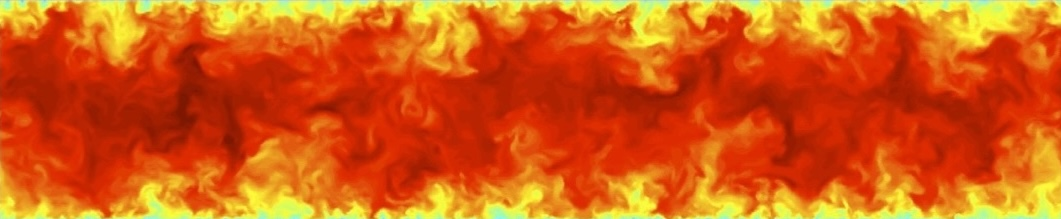
Description
These snapshots are derived from a Direct Numerical Simulation (DNS) of incompressible turbulent channel flow at a friction velocity Reynolds number of $Re_\tau \approx 1000$, which is publicly available through the Johns Hopkins Turbulence Database (JHTDB). The original simulation was performed on a computational domain of size $L_x = 8\pi h$, $L_y = 2h$, and $L_z = 3\pi h$ in the streamwise, wall-normal, and spanwise directions respectively, where $h$ is the channel half-height, discretized on a grid of $2048 \times 512 \times 1536$ nodes. Periodic boundary conditions are applied in the streamwise and spanwise directions, and no-slip/no-penetration boundary conditions are enforced at the two walls.
The flow is driven by an imposed mean pressure gradient ($dP/dx = 0.0025$); the simulation was first equilibrated at a prescribed bulk velocity of 1 before switching to the fixed pressure-gradient forcing and re-equilibrating to a statistically stationary state. The kinematic viscosity is $\nu = 5 \times 10^{-5}$ and the resulting friction velocity is $u_\tau = 0.0499$. The incompressible Navier–Stokes equations are solved using a pseudo-spectral (Fourier–Galerkin) method in the wall-parallel (x, z) planes and a 7th-order B-spline collocation method in the wall-normal (y) direction; grid points are therefore uniformly spaced in x and z but non-uniformly clustered near the walls in y.
For this machine-learning-oriented release, we subsampled the original JHTDB channel flow fields and re-saved them in a new, ML-friendly format. Each snapshot retains the complete three-dimensional flow field with all three velocity components (u, v, w) and pressure. Two versions of the dataset are provided:
- Sequential version — 20 consecutive snapshots sampled at a the stored time interval, preserving the temporal evolution of the flow. This version is intended for tasks that require temporal coherence, such as spatio-temporal forecasting, super-resolution in time, or dynamics learning.
- Random version — 10 snapshots drawn at random (non-consecutive) times. This version is intended for tasks that benefit from diverse, decorrelated samples, such as single-frame reconstruction, statistical modeling, or generative learning.
Quick Info
- Contributors: Charles Meneveau
- Nx = 2048, Ny = 512, Nz = 1536
- Nɸ = 4
- DOI
- .bib
- Download.sh
Links to different cases
| ID | Re$_{\tau}$ | Description | Size (TB) | Links |
|---|---|---|---|---|
| 0 | 1000 | Sequential Snapshots | 481 |
|
| 1 | 1000 | Collection of snapshots at different time | 241 |
|