Turbulent Premixed Flame NH3-H2-Air Quenching
DNS of turbulent head-on quenching of premixed H₂/air and NH₃/H₂/air flames in fully developed turbulent channel flows
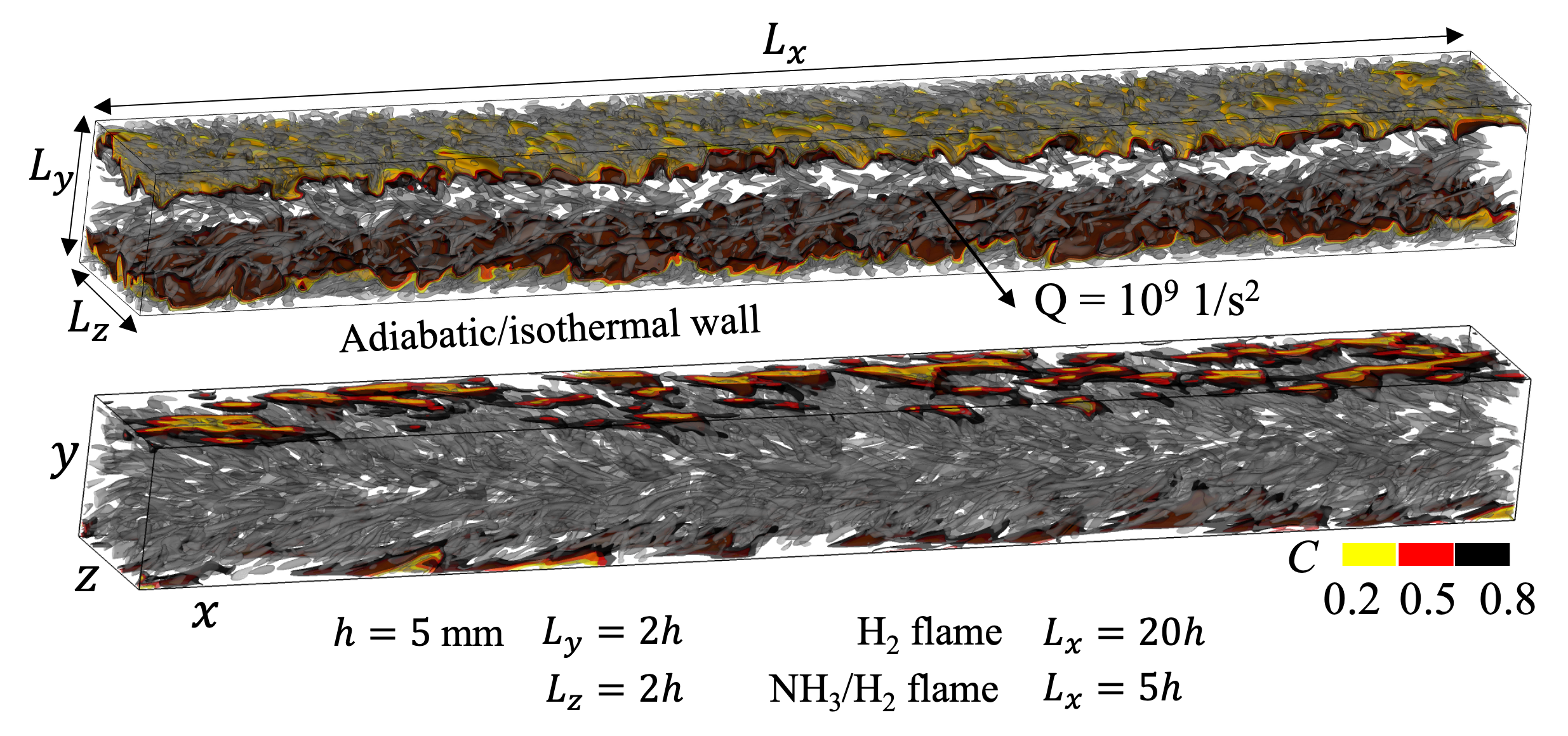
Description
Direct numerical simulations (DNS) of turbulent head-on quenching of premixed H₂/air and NH₃/H₂/air flames in fully developed turbulent channel flows at friction Reynolds number Reτ ≈ 300 were conducted. Both adiabatic and isothermal walls were considered. There are several objectives of these DNS simulations: (1) to examine near-wall flame dynamics and combustion regime variations [1]; (2) to investigate the effect of differential diffusion on quenching characteristics [2]; (3) to analyze pollutant emission characteristics for near-wall flames [3]; (4) to examine the near-wall flame marker [4] The dataset includes approximately 10 snapshots per flame configuration, spanning from flame initiation to complete flame quenching.
The DNS were performed using the in-house low-Mach combustion solver DINO [5]. The detailed NH₃ mechanism [6] and H₂ mechanism [7] were applied for NH₃/H₂/air and H₂/air flames, respectively. The mixture-averaged diffusion model was used for molecular transport. The governing equations were solved using:
- Spatial discretization: 6th order centered finite difference method
- Temporal discretization: 4th order Runge-Kutta explicit method
Non-reacting channel flows were first simulated until wall turbulence was fully developed. The channel has streamwise (x), wall-normal (y), and spanwise (z) lengths of 5h, 2h, and 2h, respectively, where h = 5 mm is the half-channel width. For hydrogen flames, the streamwise length is extended to 20h. Two identical flame fronts (mapped from 1D unstretched freely propagating flame solutions) are then initiated at y = 0.5h and y = 1.5h, with burned gases in the channel center and flames propagating toward the top and bottom cold walls. The hydrogen flames are simulated with a grid resolution Δx⁺=2.71 (uniformly 48.4 μm), Δz⁺=2.189 (uniformly 39.1 μm), and 0.437≤Δy⁺≤1.635 (stretched grids in the wall-normal direction from 7.8-29.2 μm). The ammonia/hydrogen flames are simulated with a grid resolution Δx⁺=2.023 (uniformly 32.3 μm), Δz⁺=2.448 (uniformly 39.1 μm), and 0.326≤Δy⁺≤1.215 (stretched grids in the wall-normal direction from 5.2-19.4 μm).
| Parameter | Case HI | Case AI | Case HA | Case AA |
|---|---|---|---|---|
| uτ (m/s) | 6.40 | 5.13 | 6.40 | 5.13 |
| l* (μm) | 17.86 | 15.97 | 17.86 | 15.97 |
| Reτ | 280 | 313 | 280 | 313 |
| Daw | 0.167 | 0.004 | 0.167 | 0.004 |
| α (H2 vol. ratio) | 1.0 | 0.2 | 1.0 | 0.2 |
| ϕ | 1.5 | 1.0 | 1.5 | 1.0 |
| Tu (K) | 750 | 750 | 750 | 750 |
| Tw (K) | ISO 750 | ISO 750 | AD | AD |
| SL (m/s) | 14.54 | 0.843 | 14.54 | 0.843 |
| δL (mm) | 0.243 | 0.661 | 0.243 | 0.661 |
| tw (μs) | 2.79 | 3.11 | 2.79 | 3.11 |
| tL (μs) | 16.7 | 784 | 16.7 | 784 |
Notation: uτ — friction velocity; l* = ν/uτ — viscous length scale; ν — kinematic viscosity; Reτ = huτ/ν — friction Reynolds number; Daw = tw/tL — wall Damköhler number; tw = ν/uτ² and tL = δL/SL — wall and flame time scales; SL, δL — laminar flame speed and thickness; α — fuel H₂ volume ratio; ϕ — equivalence ratio; Tu, Tw — unburned and wall temperatures; ISO — isothermal wall; AD — adiabatic wall.
Quick Info
- Contributors: Cheng Chi, Dominique Thévenin
- Nɸ = 5 + 6
- DOI
- .bib
- Download.sh
Links to different cases
| Case | Fuel | Wall | Grid | Size (GB) | Links |
|---|---|---|---|---|---|
| HI | H2 | Isothermal | 2048×513×256 | 121 |
Kaggle, info.json
|
| HA | H2 | Adiabatic | 2048×513×256 | 181 |
Kaggle, info.json |
| AI | NH3/H2 | Isothermal | 768×769×256 | 85 |
Kaggle, info.json
|
| AA | NH3/H2 | Adiabatic | 768×769×256 | 102 |
Kaggle, info.json
|
References
[1] C. Chi, B. Cuenot, D. Thévenin, Turbulent flame-wall interaction: dynamics of flame thickness and combustion regime, J. Fluid Mech. 1029 (2026) A5.
[2] C. Chi, C. Yu, B. Cuenot, U. Maas, D. Thévenin, Effect of differential diffusion on head-on quenching of premixed NH₃/H₂/air flames within turbulent boundary layers, Proc. Combust. Inst. 40 (2024) 105276.
[3] C. Chi, Flame dynamic insights into emission characteristics of NH₃/H₂/air combustion in turbulent boundary layers, Combust. Flame 269 (2024) 113723.
[4] C. Chen, C. Chi, W. Han, L. Yang, D. Thévenin, A flame marker for ammonia/hydrogen/air premixed flames during flame/wall interactions, Proc. Combust. Inst. 41 (2025) 105935.
[5] A. Abdelsamie, G. Fru, T. Oster, F. Dietzsch, G. Janiga, D. Thévenin, Towards direct numerical simulations of low-Mach number turbulent reacting and two-phase flows using immersed boundaries, Comput. Fluids 131 (2016) 123–141.
[6] Y. Jiang, A. Gruber, K. Seshadri, F. Williams, An updated short chemical-kinetic nitrogen mechanism for carbon-free combustion applications, Int. J. Energy Res. 44(2) (2020) 795–810.
[7] J. Li, Z. Zhao, A. Kazakov, F.L. Dryer, An updated comprehensive kinetic model of hydrogen combustion, Int. J. Chem. Kinet. 36(10) (2004) 566–575.